The Exiles
Where the faithful went, why they went there, and what their departure reveals about what was done to them

THE DESOLATION WITHIN
Article Eight
SERIES LINKS: Introduction, Article One, Article Two, Supplemental Article, Article Three, Article Four, Article Five, Article Six, Article Seven, Article Eight (this article)
— — —
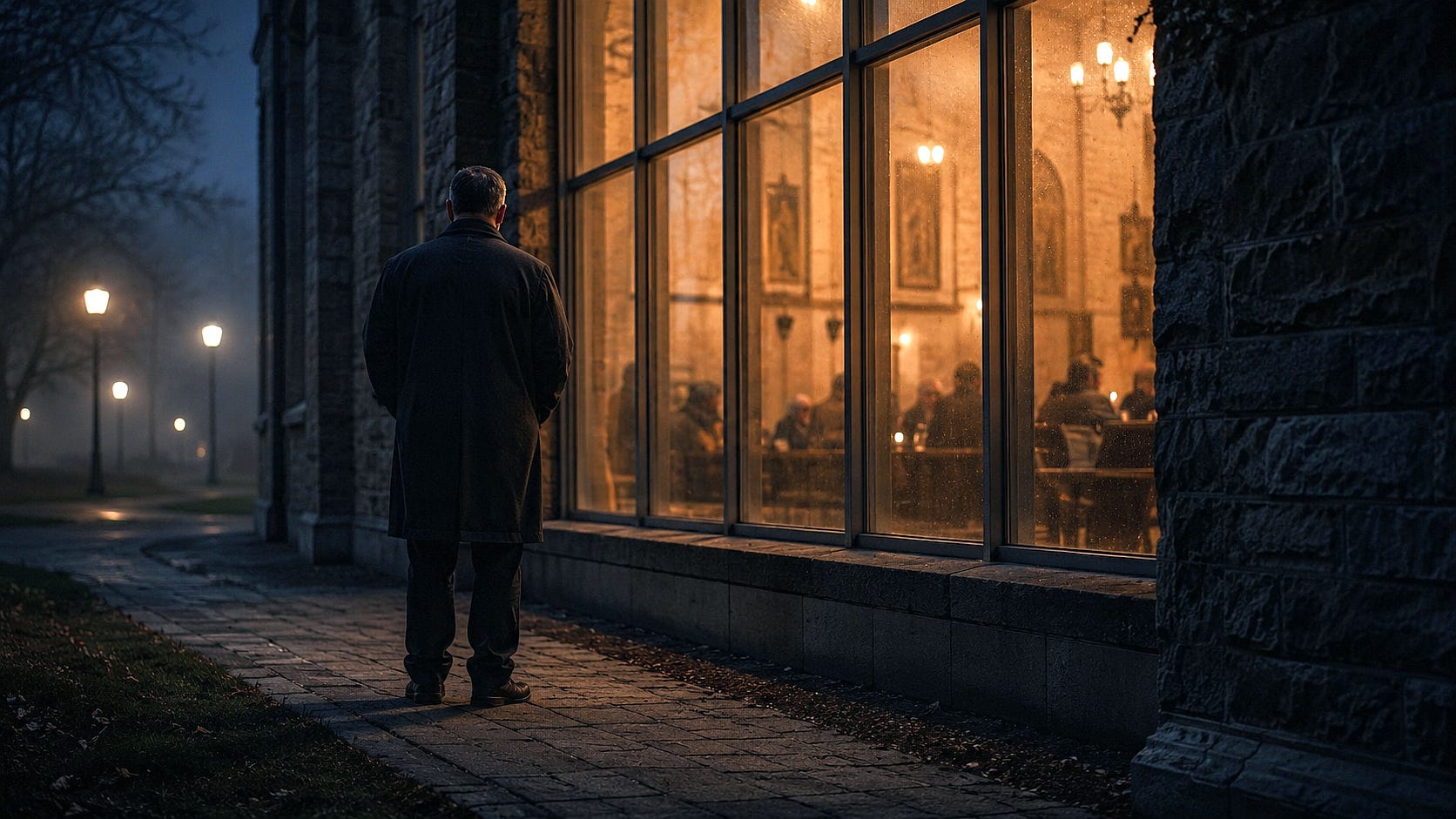
The people this article describes left because they believed. They believed deeply enough that what was being done to the Church felt impossible to stay inside and ignore. Some went to Eastern Orthodoxy. Some went to communities outside canonical communion with Rome. Some arrived at sedevacantist positions. Some simply stopped going to Mass altogether. Each departure has a different theological character. All of them share a common cause.
The cause is the desolation this series has been tracing. When the center fails, the faithful nearest the center are the first to feel the shockwave. The exiles are frequently among the most serious Catholics. Their departure is evidence of how deep the wound went.
Those Who Went to Orthodoxy
The Eastern Orthodox Church has been receiving Catholic converts for decades. The rate accelerated during the Francis years.
The profile of those who went is specific. They were serious Catholics who had invested heavily in their faith: theology graduates, homeschooling families, people who had built their entire way of life around Catholic practice. They were precisely the people a Church in demographic decline could least afford to lose.
What Orthodoxy offered them was what Catholicism had ceased to offer reliably: a liturgy of unchanged antiquity and a hierarchy that had not spent the previous decade issuing ambiguous documents on foundational questions. Orthodoxy had not produced its own Amoris Laetitia. Its bishops had not signed the Abu Dhabi Declaration. Its traditional liturgy had not been suppressed by papal decree.
The converts to Orthodoxy are people who concluded that the institution charged with upholding Catholic doctrine had stopped upholding it consistently. They went somewhere where the holding was more reliable. Orthodoxy has its own significant difficulties, including the fractures that became acute during this same period.[1] Catholics do not move to Orthodoxy because they have solved the filioque controversy. They move because they cannot reconcile what the Church they belong to is doing with what they know the Church is supposed to be.
The Francis era opened that gap. The converts to Orthodoxy stepped into it.
Those Who Went to Sedevacantism
Sedevacantism is the position that the chair of Peter is vacant: that the men who have held the papal office since the Second Vatican Council are not validly elected popes because they have taught heresy, and that a heretic cannot hold the papacy. A small minority of traditionally-minded Catholics holds the position. It is theologically untenable for reasons the tradition makes clear. It is also the position that a particular kind of serious Catholic arrives at when the institutional contradictions become too acute to resolve any other way.
The sedevacantist cared enough about the papacy’s doctrinal integrity that when he concluded it had been lost, he drew the logical consequence. The conclusion is theologically wrong. The underlying instinct—that the papacy exists to protect truth, and that an institution that systematically undermines truth has failed at its essential function—is sound.
The Francis era did not create sedevacantism. It fed it. Every ambiguous document, every refused answer to a formal theological question, every appointment of a figure whose theology was manifestly incompatible with the tradition, supplied new material to people who had already concluded that the conciliar church was not the true church. The Francis years were a recruitment tool for a position that the Church’s own actions made more difficult to argue against.
A Catholic who watched the pope apologize for the removal of a pagan figure from a Catholic church, retrieve it from the river, and carry it in procession into the Paul VI Audience Hall[2] was given something very hard to explain without concluding that the person in the papal office does not hold what the papal office is supposed to hold. The sedevacantist draws the wrong conclusion from that observation. The observation itself is a description of what happened.
Those Who Left Christianity
Faith is not simply a set of propositions held in the mind. It is a way of inhabiting the world, a set of practices, relationships, and commitments that constitute a form of life. When the institution that has mediated that faith to a person begins to undermine the propositions on which it is founded, its practices and relationships do not necessarily survive. The cognitive dissonance is not merely intellectual. It is existential.
A Catholic who was taught that the Church is the guardian and transmitter of divine truth, and who then watched the Church issue document after document that seemed to contradict or qualify or deliberately obscure that truth, faced a choice that most people are not equipped to navigate without pastoral support. The Church, which should have provided that support, was the source of the confusion. There was no clear voice. There was no stable ground. There was only the ambiguity, the accusations of rigidity directed at those who pointed it out, and the silence from the institution that should have resolved it.
Some people left. The departure was not a conclusion about God. It was a conclusion about the institution. The institution had always been their access point to faith, and it had become unreliable in ways they could not integrate. They lacked the theological training to distinguish between the Church’s indefectibility as a doctrinal reality and the observable failures of its human leadership. They experienced the failures and concluded that faith itself could not sustain them.
These are the people the shepherd is supposed to find. They were driven into the wilderness by the shepherd’s house.
The Dispersal of the TLM Communities
Article Five described the suppression of the Traditional Latin Mass communities. This article addresses what happened to the people in them afterward.
They dispersed. Some found permitted Masses within their dioceses and attended them, sometimes traveling significant distances. Some moved to dioceses with more generous bishops. Some went to Society of Saint Pius X chapels and accepted canonical irregularity as the price of the Mass that had formed their faith. Some—particularly in dioceses that implemented Traditionis Custodes aggressively—lost regular access to a traditional liturgy entirely and faced a choice between attending an ordinary-form Mass after years in the traditional form or not attending at all.
My wife and I chose the Pacific Northwest because a particular community there could not be shut down by papal decree. We were not unique. The calculation we made—which community offers the greatest security against further institutional action—is one that thousands of Catholic families made after July 2021. Families who had built their entire Catholic lives around a particular parish community, who had formed friendships, educated their children, and buried their parents within that community, were scattered by a document that characterized their liturgy as a threat to unity.
The irony is precise. Traditionis Custodes was issued in the name of unity. Its practical effect was to divide the Church along its most committed fracture line, driving its most orthodox families into communities operating outside full canonical communion with Rome. The document designed to protect unity produced exactly the division it claimed to oppose.
Francis Fatigue
Not all the exiles left physically. Some left in a more interior way.
Francis fatigue is the term that emerged in Catholic writing during the later years of the pontificate. It describes a condition: a Catholic who remains in the Church, attends Mass, continues the practices of the faith, but has withdrawn psychological investment from the institutional Church at the level of trust, hope, and engagement. The person is present. Their presence is hollowed.
This category is vastly larger than the categories of formal departure. It includes people who stopped reading Catholic news because the news was uniformly demoralizing. It includes people who stopped engaging in conversations about Church affairs because those conversations produced only frustration. It includes people who go to Mass, receive the sacraments, say the prayers, and have stopped expecting the institution to be what it claims to be.
The hollowing of Catholic life at the level of ordinary faithful is not visible in statistics. It does not show up in departure records. It shows up in the texture of Catholic culture: in the quality of engagement at parish councils, in the willingness of the faithful to invest in institutions, in the appetite for evangelization. A person who has lost confidence in the institution’s integrity does not evangelize for it with conviction. They cannot. They do not believe, at the level where evangelization is generated, that what they would be inviting people into is reliable.
This is perhaps the most serious damage the era has produced. The exiles who left entirely are visible and countable. The exiles who remained and hollowed are neither. They are simply there, diminished, going through motions whose deeper meaning they can no longer sustain with full confidence.
What the Departures Reveal
Every departure is a testimony, and the form of the departure tells us what the departing person needed and could not find.
Those who went to Orthodoxy needed doctrinal stability and liturgical continuity. The Catholic Church had provided both for most of its history. During the Francis era, the provision became unreliable, and they went elsewhere to find it.
Those who went to sedevacantism needed the papacy to be what it claims to be. Their conclusion about what it had become was wrong. The need behind that conclusion was legitimate, and it went unmet.
Those who left Christianity needed an institution capable of holding their faith when their own strength was insufficient. The institution was the source of the crisis rather than its resolution. They had nowhere left to stand.
Those whose TLM communities were dispersed needed a spiritual home. The institution they belonged to dismantled theirs and offered no equivalent in return.
Those who remained and were hollowed needed to trust the institution’s integrity enough to invest in it. A decade of institutional behavior gave them reasons not to. The investment withdrew, and with it, the interior life it had sustained.
None of these needs was unreasonable. All of them are needs the Church exists to meet. The exiles are the record of its failure to meet them.
Where This Stands Today
The exiles are still leaving.
The conditions that produced the departures described in this article have not been reversed. Traditionis Custodes remains in force. The doctrinal ambiguity of Amoris Laetitia remains unresolved. The Abu Dhabi Declaration stands. The culture of fear in the Church’s institutions has not been formally addressed. The families who were scattered from their TLM communities have not been formally invited back.
The SSPX situation is the present-tense version of this article’s subject. Catholics in the Society’s chapels today are there because the conditions that drove them there have not been corrected. Many would prefer full canonical communion with Rome. The regularization they want requires Rome to offer terms compatible with what drove them out. Those terms have not been offered. Leo’s warm gestures toward traditional communities—his greeting to the Paris-Chartres pilgrimage—exist alongside a decree that still characterizes their liturgy as a threat to unity. The gesture and the decree cannot both be sincere. The faithful are watching to see which one governs.
The converts to Orthodoxy have not been given a reason to reconsider. No clarification has been issued. No document has been corrected. The gap they stepped into when they left remains open.
Those who left Christianity are not waiting for a document. They are waiting for evidence that the institution is trustworthy. A warmer tone from a new pope is a data point, not evidence. Evidence requires consistent action over time. The people who left based on what they observed need to observe something different, sustained across years, before it reaches them.
The hollowed faithful are still in the pews. They can be recovered. Recovery requires clarity, sustained over time, on the questions that produced the hollowing. That clarity has not yet been sustained. The hollowing continues.
— — —
The Danielic pattern names this: when the center is compromised, the desolation radiates outward. The exiles are not the center of the catastrophe. They are its outermost ring.
They are still there. The ring is still expanding.
Nothing has been done to stop it.
The Desolation Within is a series of twelve articles. Article Eight examines the Catholics who left and those who remained hollowed. Article Nine will examine the German question: the most acute present-tense test of whether Leo XIV will hold the line Francis did not hold. If your own departure or diminishment is reflected in this article, the author welcomes your account. You are not alone, and your experience is not a failure of faith.
[1] The fractures within Eastern Orthodoxy during this period include the break between the Ecumenical Patriarchate of Constantinople and the Russian Orthodox Church following the granting of autocephaly to the Orthodox Church of Ukraine in 2019, and ongoing disputes over primacy and conciliarity among the autocephalous Orthodox churches. These divisions are noted here to qualify any claim that Orthodoxy presents a uniformly stable institutional alternative to Rome. They have not prevented Orthodoxy from receiving Catholic converts.
[2] The Pachamama figures were carried in procession to the Church of Santa Maria in Traspontina, near the Vatican, where they were venerated. They were subsequently removed from the church and thrown into the Tiber by a group of Catholic laymen. Pope Francis apologized for the removal and retrieved the figures. They were then carried in procession into the Paul VI Audience Hall for a closing ceremony of the Amazon Synod. They were not brought into Saint Peter’s Basilica. The distinction matters and is maintained throughout this account.
I will throw in Benevacantism, which I personally hold, and I think less untenable than full '58 sedevacantism.